
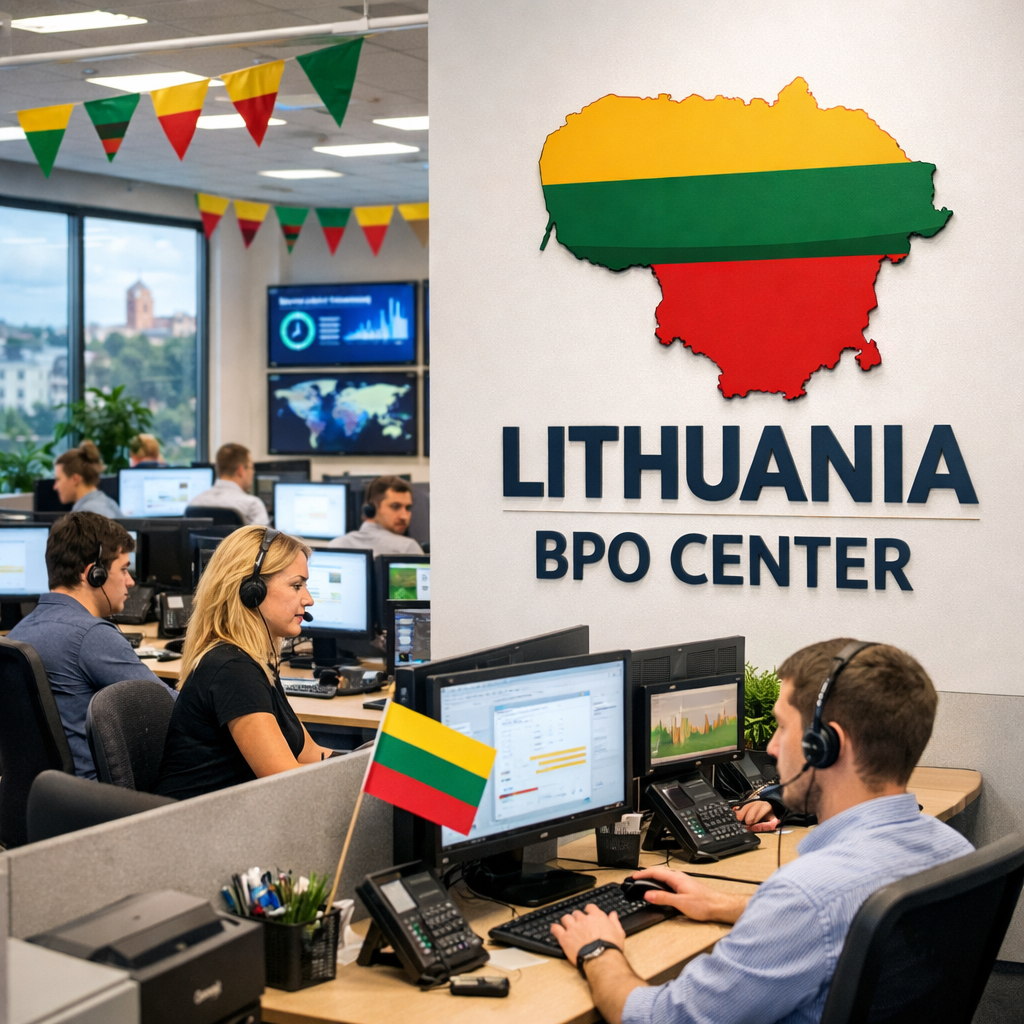

For years, when companies thought about opening a Business Process Outsourcing (BPO) operation in Europe, the same countries kept coming up: Poland, the Czech Republic, maybe Romania. Lithuania rarely made the shortlist.
That has changed — quietly, steadily, and very deliberately.
Today, Lithuania is no longer just a “small Baltic state.” It is becoming one of the most practical, flexible, and business-friendly BPO locations in the European Union, especially for founders who need access to international talent, predictable immigration rules, and EU credibility without Western European costs.
This article explains why Lithuania works, how a BPO can be established, and what real-world considerations actually matter — beyond marketing slogans.
A Realistic Starting Point: Can You Open a BPO in Lithuania?
The short answer is yes.
The longer, more important answer is: yes — if you do it correctly.
Lithuania fully allows BPO and shared services activities under its commercial and corporate laws. This includes, but is not limited to:
-
Customer support and call centres
-
Back-office operations
-
IT and technical support
-
Finance, accounting, and data processing
-
Online platform support and moderation
-
Gaming, entertainment, and live-service support
However, one detail often overlooked by first-time founders is that generic business descriptions create problems. Immigration authorities, banks, and regulators all want clarity. A BPO that says “we provide outsourcing services” raises questions. A BPO that clearly explains who it serves, what tasks are outsourced, and how value is created moves much faster.
This clarity becomes especially important when foreign staff are involved.
The Human Side of BPO: Talent Is Everything
Every successful BPO story starts with people.
Lithuania has a strong local workforce — multilingual, EU-educated, and tech-literate. But many BPOs, especially those serving Asian, Middle Eastern, or niche international markets, need overseas staff for language, cultural, or operational reasons.
Lithuania allows this — and more flexibly than many founders expect.
Can You Hire Foreign Workers in Lithuania?
Yes. There is no fixed legal cap on the number of foreign employees a Lithuanian company may hire.
What matters instead is economic substance.
Immigration authorities look at questions such as:
-
Is the company genuinely operating in Lithuania?
-
Is it paying corporate taxes or only payroll taxes?
-
Does it have real clients and revenue?
-
Are salaries aligned with market averages?
A company that generates profit in Lithuania and pays corporate income tax is treated very differently from a company that exists only as a payroll vehicle.
This is where many BPO founders either succeed — or stall.
The Three Core Requirements for Overseas Staff
In practice, most foreign employees can be hired if they meet three straightforward criteria:
-
Qualifications or Certification
The employee must have a degree or professional certification relevant to the role, where required. -
Market-Level Salary
The offered salary must meet or exceed the Lithuanian market average for that position. Underpaying is the fastest way to trigger rejection. -
Relevant Experience
Typically, at least one year of proven work experience is expected.
These are not unusual demands — but consistency matters.
Scaling Up: What Happens When You Reach 50+ Employees?
Once a BPO grows beyond the needed numbers, the conversation changes again.
At this level, companies may engage directly with the Ministry of Foreign Affairs to discuss improved conditions for employing foreign nationals. This can include:
-
More predictable immigration approvals
-
Better long-term workforce planning
-
Structured cooperation with state institutions
In short, Lithuania starts treating you less like a small applicant — and more like an employer of national interest.
Why Lithuania Works as a European Union BPO Hub
Beyond laws and permits, there is a bigger picture.
Lithuania offers:
-
Full European Union access
-
Stable, transparent regulation
-
Competitive operating costs
-
A pro-business government mindset
-
A growing ecosystem of shared services and tech companies
For founders who want an EU base without EU bureaucracy overload, Lithuania often hits the sweet spot.
Final Thoughts: A Quiet Success Story in the EU
Lithuania’s rise as a BPO destination is not driven by hype. It is driven by practicality.
It works because:
-
The rules are clear (if you understand them)
-
Immigration is flexible (if you structure correctly)
-
The government rewards real economic contribution
-
Scaling is possible without constant regulatory friction
For companies willing to plan properly, define their business clearly, and invest with a long-term view, Lithuania is not just an option — it is one of the smartest BPO plays in the European Union today.
